
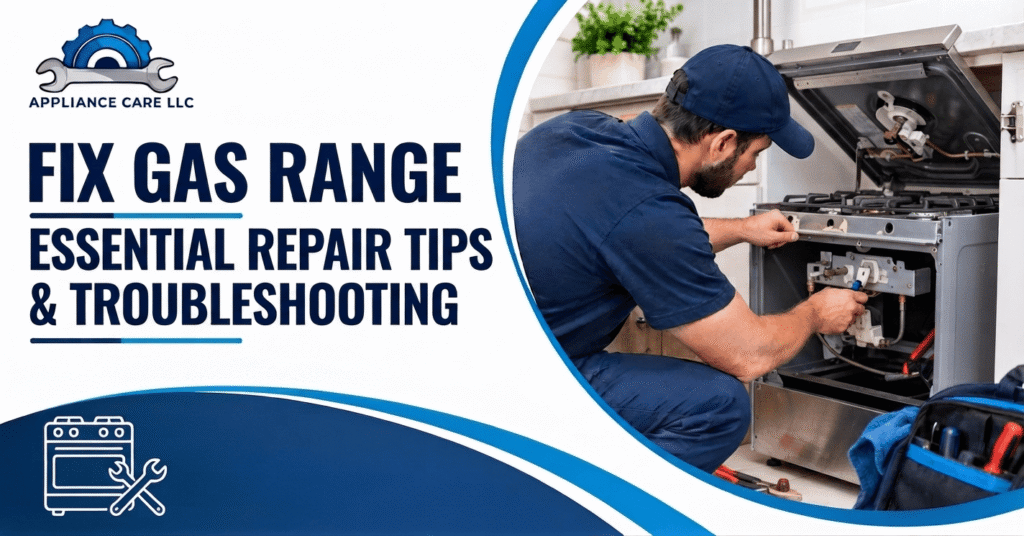
A gas range is a vital appliance in many kitchens. When it starts to malfunction, it can disrupt your cooking and meal preparation. Common issues include faulty igniters, uneven heating, and burners that won’t light. Learning how to fix these problems can save you time and money.
In this article, you’ll find essential tips for troubleshooting and repairing your gas range. Whether you’re dealing with a stubborn burner or an igniter issue, we’ve got you covered. Let’s dive into practical solutions that can help get your gas stove back in working order.
What Should You Check First When a Gas Range Won’t Work?
Start with safety, power, gas supply, burner alignment, and cleanliness before you touch parts. Many gas oven troubleshooting steps come down to basic issues: a burner cap sitting crooked, moisture near the electrode, food blocking burner ports, a closed gas valve, or a weak igniter that can’t open the safety valve. GE and LG both point to wet or dirty burner parts, incorrect cap placement, and gas valve position as common causes of ignition trouble. (products.geappliances.com)
If you smell gas, don’t keep testing burners. Turn everything off, avoid switches or flames, leave the area, and call your gas provider or emergency services. That’s not dramatic; it’s just the line you don’t cross.
Use this quick first-pass checklist:
- Make sure the range is plugged in, since many gas ranges still need electricity for ignition.
- Confirm the gas shutoff valve is open if you can access it safely.
- Check whether all burners fail or just one burner fails.
- Remove and reseat burner caps after they’ve cooled.
- Look for wet areas from cleaning or a boil-over.
- Clear visible food debris from burner ports with a soft brush or pin, without enlarging the holes.
- Check the owner’s manual before removing panels or ordering parts.
Burner Problems Usually Start at the Top
If you’re asking how to fix gas range burner issues, begin with the part you can actually see. Surface burners need the cap, burner head, ports, and electrode to line up properly. A cap that’s slightly off-center can keep the flame from spreading, and a wet electrode can click without lighting.
For one burner that clicks but won’t light, clean and dry the burner assembly first. Lift off the grate and cap once everything is cool, brush away crumbs, and wipe the area with a dry cloth. If the burner was recently washed, give it extra drying time. GE notes that wet or dirty burners can cause slow ignition, no ignition, or clicking until the ports dry and clear. (products.geappliances.com)
If the burner lights with a match but not with the igniter, the gas path may be fine while the spark system is not. If there’s no click at all on one burner, you may be looking at a bad spark switch, loose wire, cracked electrode, or failed spark module. That’s when a simple gas stove fix turns into a diagnosis, not cleaning.
How Do You Fix a Gas Range Igniter?
To fix gas range igniter trouble, first decide whether you’re dealing with a surface burner spark igniter or an oven hot-surface igniter. Surface burners usually make a clicking spark, while many gas ovens use a glow igniter that gets hot enough to open the gas safety valve and light the bake burner. Repair guides commonly warn that an oven igniter can glow but still be too weak to light the burner properly. (fix.com)
For a cooktop igniter, try this order:
- Turn the burner off and let everything cool.
- Remove the grate, cap, and burner head if your model allows it.
- Clean around the electrode with a dry toothbrush or soft cloth.
- Dry the area fully, especially after spills.
- Reseat the burner head and cap.
- Test the burner again.
For an oven igniter, don’t keep cycling the oven if it won’t light. Watch for symptoms instead: no glow, weak glow, long preheat, gas smell, or burner ignition that takes too long. If you know how to fix gas range igniter parts and your manual supports replacement, unplug the range, shut off the gas if required, and use the exact compatible part. If you don’t have the right tools or you’re unsure how the safety valve works, call a technician. Guessing with gas isn’t a badge of honor.
Oven Heating Problems Need a Different Approach
A cooktop burner that won’t light and an oven that won’t heat are related, but they’re not the same repair. Gas ovens rely on an ignition sequence. The control calls for heat, the igniter energizes, the safety valve opens only when conditions are right, and the burner lights. If one step fails, dinner stays cold.
Good gas oven troubleshooting starts with pattern spotting:
- The cooktop works, but the oven doesn’t heat: the gas supply may be fine, so check the bake igniter, oven control, sensor, or safety valve.
- The oven igniter glows, but the burner never lights: the igniter may be too weak, even if it looks alive.
- The broiler works, but the bake doesn’t: the bake igniter or bake circuit deserves attention.
- Neither bake nor broil works: look at power, controls, gas supply, or a broader electrical issue.
- The oven heats slowly: don’t ignore it. A weak igniter can create long preheats before it fails fully.
This is where many DIY articles get too casual. Replacing an igniter can be doable, but testing amperage, live voltage, wiring, and gas valves isn’t casual weekend tinkering. If the repair requires live testing, it’s time for trained help.
Brand and Model Searches Can Help, but Don’t Trust Them Blindly
Brand-specific searches are useful when you need diagrams, part numbers, or control behavior. For example, someone searching “how to fix Frigidaire gas oven frigidaire range fgf368gsg” is probably trying to identify the right Frigidaire model steps or igniter part. The spelling doesn’t matter as much as the model number, because model-specific manuals and parts lists are what keep you from ordering the wrong component.
The same goes for how to fix Samsung gas range knob issues. A loose or cracked knob is very different from a stuck valve stem behind the knob. If the plastic knob is cracked, replacement may be simple. If the metal stem is hard to turn, won’t spring back, or smells like gas, stop using that burner and get service.
Before buying parts, write down:
- Full model number from the rating label.
- Serial number if the parts site asks for it.
- Exact symptom, not just “broken.”
- Whether the issue affects one burner, all burners, bake, broil, or the knobs.
- Any error code shown on the display.
That small habit saves money. It also keeps you from replacing a spark module when the real issue is a wet burner cap.
Smart DIY Repairs Have Limits
You can fix gas stove problems confidently when the task is cleaning, drying, reseating caps, checking the plug, or replacing an obvious removable knob with a matching part. You might also handle a gas range fix like replacing a bake igniter if you’re comfortable following the manual, disconnecting power, and accessing the part without forcing panels.
You shouldn’t DIY a repair that involves a gas leak, a damaged gas line, a suspected regulator issue, live electrical testing, a seized valve, or repeated ignition failure after cleaning. You also shouldn’t bypass a safety device or manually light an oven that’s designed for electronic ignition. That’s not clever; it’s dangerous.
Here’s a practical decision rule: if the repair requires observation, cleaning, or a compatible plug-in style part, it may be reasonable. If it requires proving gas pressure, measuring current, testing a safety valve, or interpreting control-board output, book the repair.
Preventing Repeat Ignition Problems
Once you fix gas range issues, keep them from coming back. Most recurring burner complaints come from grease, water, misaligned caps, and rough cleaning habits. Scrubbing too aggressively around electrodes can crack ceramic or loosen wiring, while soaking burner heads and reinstalling them wet almost guarantees clicking.
Build these habits into normal kitchen cleanup:
- Wipe spills after the burner cools, not days later.
- Dry burner parts fully before reinstalling them.
- Keep ports clear, but don’t drill or enlarge them.
- Place caps flat and centered every time.
- Avoid spraying cleaner directly into knob openings.
- Listen for changes, such as slower ignition or endless clicking.
- Keep the manual where you can find it.
A range doesn’t need fussy treatment, but it does need consistent care. Small messes around flame and spark parts create outsized problems.
How DMV Appliance Care Can Help
If your gas range is still acting up after trying the basics, that is where DMV Appliance Care comes in. Their team helps homeowners figure out what is actually wrong, whether it is a faulty igniter, uneven heating, or a burner that just will not light, without any guesswork involved.
Before any work starts, they walk you through what the issue is, what can be fixed, and what to expect, so you are never left in the dark about your own kitchen. Their focus stays on careful service and clear communication from start to finish.
If cleaning and basic troubleshooting have not solved the problem, you can reach out to DMV Appliance Care and let a trained technician take it from there.
Conclusion
Knowing how to fix gas range problems starts with separating simple symptoms from risky ones. Clean the burner, dry the igniter area, reseat the cap, check power, and use your model number before buying anything. For igniters, safety valves, wiring, and gas supply issues, don’t bluff your way through.
A good gas range repair is the one that solves the real problem without creating a bigger one. Start simple, stay skeptical, and call a pro when the issue moves beyond cleaning and basic part replacement.
Frequently Asked QuestionsA gas range is a vital appliance in many kitchens. When it starts to malfunction, it can disrupt your cooking and meal preparation. Common issues include faulty igniters, uneven heating, and burners that won’t light. Learning how to fix these problems can save you time and money.
In this article, you’ll find essential tips for troubleshooting and repairing your gas range. Whether you’re dealing with a stubborn burner or an igniter issue, we’ve got you covered. Let’s dive into practical solutions that can help get your gas stove back in working order.
What Should You Check First When a Gas Range Won’t Work?
Start with safety, power, gas supply, burner alignment, and cleanliness before you touch parts. Many gas oven troubleshooting steps come down to basic issues: a burner cap sitting crooked, moisture near the electrode, food blocking burner ports, a closed gas valve, or a weak igniter that can’t open the safety valve. GE and LG both point to wet or dirty burner parts, incorrect cap placement, and gas valve position as common causes of ignition trouble. (products.geappliances.com)
If you smell gas, don’t keep testing burners. Turn everything off, avoid switches or flames, leave the area, and call your gas provider or emergency services. That’s not dramatic; it’s just the line you don’t cross.
Use this quick first-pass checklist:
- Make sure the range is plugged in, since many gas ranges still need electricity for ignition.
- Confirm the gas shutoff valve is open if you can access it safely.
- Check whether all burners fail or just one burner fails.
- Remove and reseat burner caps after they’ve cooled.
- Look for wet areas from cleaning or a boil-over.
- Clear visible food debris from burner ports with a soft brush or pin, without enlarging the holes.
- Check the owner’s manual before removing panels or ordering parts.
Burner Problems Usually Start at the Top
If you’re asking how to fix gas range burner issues, begin with the part you can actually see. Surface burners need the cap, burner head, ports, and electrode to line up properly. A cap that’s slightly off-center can keep the flame from spreading, and a wet electrode can click without lighting.
For one burner that clicks but won’t light, clean and dry the burner assembly first. Lift off the grate and cap once everything is cool, brush away crumbs, and wipe the area with a dry cloth. If the burner was recently washed, give it extra drying time. GE notes that wet or dirty burners can cause slow ignition, no ignition, or clicking until the ports dry and clear. (products.geappliances.com)
If the burner lights with a match but not with the igniter, the gas path may be fine while the spark system is not. If there’s no click at all on one burner, you may be looking at a bad spark switch, loose wire, cracked electrode, or failed spark module. That’s when a simple gas stove fix turns into a diagnosis, not cleaning.
How Do You Fix a Gas Range Igniter?
To fix gas range igniter trouble, first decide whether you’re dealing with a surface burner spark igniter or an oven hot-surface igniter. Surface burners usually make a clicking spark, while many gas ovens use a glow igniter that gets hot enough to open the gas safety valve and light the bake burner. Repair guides commonly warn that an oven igniter can glow but still be too weak to light the burner properly. (fix.com)
For a cooktop igniter, try this order:
- Turn the burner off and let everything cool.
- Remove the grate, cap, and burner head if your model allows it.
- Clean around the electrode with a dry toothbrush or soft cloth.
- Dry the area fully, especially after spills.
- Reseat the burner head and cap.
- Test the burner again.
For an oven igniter, don’t keep cycling the oven if it won’t light. Watch for symptoms instead: no glow, weak glow, long preheat, gas smell, or burner ignition that takes too long. If you know how to fix gas range igniter parts and your manual supports replacement, unplug the range, shut off the gas if required, and use the exact compatible part. If you don’t have the right tools or you’re unsure how the safety valve works, call a technician. Guessing with gas isn’t a badge of honor.
Oven Heating Problems Need a Different Approach
A cooktop burner that won’t light and an oven that won’t heat are related, but they’re not the same repair. Gas ovens rely on an ignition sequence. The control calls for heat, the igniter energizes, the safety valve opens only when conditions are right, and the burner lights. If one step fails, dinner stays cold.
Good gas oven troubleshooting starts with pattern spotting:
- The cooktop works, but the oven doesn’t heat: the gas supply may be fine, so check the bake igniter, oven control, sensor, or safety valve.
- The oven igniter glows, but the burner never lights: the igniter may be too weak, even if it looks alive.
- The broiler works, but the bake doesn’t: the bake igniter or bake circuit deserves attention.
- Neither bake nor broil works: look at power, controls, gas supply, or a broader electrical issue.
- The oven heats slowly: don’t ignore it. A weak igniter can create long preheats before it fails fully.
This is where many DIY articles get too casual. Replacing an igniter can be doable, but testing amperage, live voltage, wiring, and gas valves isn’t casual weekend tinkering. If the repair requires live testing, it’s time for trained help.
Brand and Model Searches Can Help, but Don’t Trust Them Blindly
Brand-specific searches are useful when you need diagrams, part numbers, or control behavior. For example, someone searching “how to fix Frigidaire gas oven frigidaire range fgf368gsg” is probably trying to identify the right Frigidaire model steps or igniter part. The spelling doesn’t matter as much as the model number, because model-specific manuals and parts lists are what keep you from ordering the wrong component.
The same goes for how to fix Samsung gas range knob issues. A loose or cracked knob is very different from a stuck valve stem behind the knob. If the plastic knob is cracked, replacement may be simple. If the metal stem is hard to turn, won’t spring back, or smells like gas, stop using that burner and get service.
Before buying parts, write down:
- Full model number from the rating label.
- Serial number if the parts site asks for it.
- Exact symptom, not just “broken.”
- Whether the issue affects one burner, all burners, bake, broil, or the knobs.
- Any error code shown on the display.
That small habit saves money. It also keeps you from replacing a spark module when the real issue is a wet burner cap.
Smart DIY Repairs Have Limits
You can fix gas stove problems confidently when the task is cleaning, drying, reseating caps, checking the plug, or replacing an obvious removable knob with a matching part. You might also handle a gas range fix like replacing a bake igniter if you’re comfortable following the manual, disconnecting power, and accessing the part without forcing panels.
You shouldn’t DIY a repair that involves a gas leak, a damaged gas line, a suspected regulator issue, live electrical testing, a seized valve, or repeated ignition failure after cleaning. You also shouldn’t bypass a safety device or manually light an oven that’s designed for electronic ignition. That’s not clever; it’s dangerous.
Here’s a practical decision rule: if the repair requires observation, cleaning, or a compatible plug-in style part, it may be reasonable. If it requires proving gas pressure, measuring current, testing a safety valve, or interpreting control-board output, book the repair.
Preventing Repeat Ignition Problems
Once you fix gas range issues, keep them from coming back. Most recurring burner complaints come from grease, water, misaligned caps, and rough cleaning habits. Scrubbing too aggressively around electrodes can crack ceramic or loosen wiring, while soaking burner heads and reinstalling them wet almost guarantees clicking.
Build these habits into normal kitchen cleanup:
- Wipe spills after the burner cools, not days later.
- Dry burner parts fully before reinstalling them.
- Keep ports clear, but don’t drill or enlarge them.
- Place caps flat and centered every time.
- Avoid spraying cleaner directly into knob openings.
- Listen for changes, such as slower ignition or endless clicking.
- Keep the manual where you can find it.
A range doesn’t need fussy treatment, but it does need consistent care. Small messes around flame and spark parts create outsized problems.
How DMV Appliance Care Can Help
If your gas range is still acting up after trying the basics, that is where DMV Appliance Care comes in. Their team helps homeowners figure out what is actually wrong, whether it is a faulty igniter, uneven heating, or a burner that just will not light, without any guesswork involved.
Before any work starts, they walk you through what the issue is, what can be fixed, and what to expect, so you are never left in the dark about your own kitchen. Their focus stays on careful service and clear communication from start to finish.
If cleaning and basic troubleshooting have not solved the problem, you can reach out to DMV Appliance Care and let a trained technician take it from there.
Conclusion
Knowing how to fix gas range problems starts with separating simple symptoms from risky ones. Clean the burner, dry the igniter area, reseat the cap, check power, and use your model number before buying anything. For igniters, safety valves, wiring, and gas supply issues, don’t bluff your way through.
A good gas range repair is the one that solves the real problem without creating a bigger one. Start simple, stay skeptical, and call a pro when the issue moves beyond cleaning and basic part replacement.
Frequently Asked Questions:
What should I do if my gas range won’t ignite?
If your gas range won’t ignite, start by checking the power supply and ensuring the gas shutoff valve is open. Clean the burner caps and ensure they are correctly seated. If the igniter is clicking but not lighting, it may be wet or faulty and needs inspection.
How can I tell if my gas range igniter is bad?
Signs of a bad gas range igniter include it clicking without lighting the burner, glowing weakly, or not glowing at all. If the igniter glows but does not ignite the gas, it may not be generating enough heat.
Can I fix a gas range myself, or should I call a technician?
You can handle minor fixes like cleaning burners and replacing igniters if you are comfortable working with appliances. However, for issues involving gas leaks, electrical problems, or complex wiring, it’s safer to consult a technician.
What causes a gas range to heat unevenly?
Uneven heating can be caused by blocked burner ports, a malfunctioning igniter, or a problem with the oven’s control system. Check for food debris and ensure that burner caps are properly aligned.
How do I maintain my gas range to prevent future issues?
Regular maintenance is crucial. Clean spills promptly, keep burner ports clear of debris, and ensure that caps are properly aligned. Regularly inspect the igniters and burners for any signs of wear and tear.