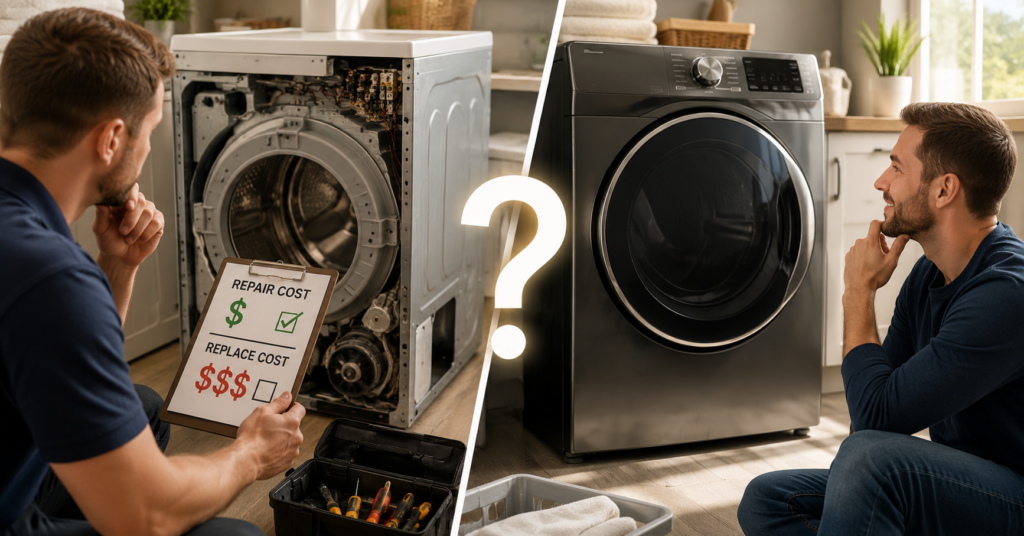
When your dryer breaks down, the first question is simple: is it better to repair or replace the dryer? The answer depends on four things: how old the dryer is, which part failed, how often it has needed repairs and what a new dryer will really cost once delivery and installation are included. In many cases a repair is cheaper and gives you years more use. In others, putting money into an old dryer does not pay off. This guide walks you through each factor so you can decide with confidence.
At Appliance Care, we help homeowners across Alexandria and the wider Northern Virginia and DMV area work through this decision honestly every week. Here’s every factor worth weighing before you commit either way.
Is It Cheaper to Repair or Replace a Dryer? Start With the 50 Percent Rule
Most appliance professionals lean on a simple guideline: if the repair quote comes in above 50 percent of the cost of a new comparable dryer, replacement usually makes more financial sense. Below that line, repair is typically the smarter move.
A new mid-range dryer runs between $500 and $800. That puts most repairs under $300 solidly in “worth fixing” territory, while quotes above $400 on an older unit start tilting toward replacement.
This one rule settles most of these decisions on its own. The factors below help with the cases that fall in between.
Factor 1: How Old Is Your Dryer? (Repair or Replace an Old Dryer)
Age plays a bigger role in this decision than almost anything else.
Under 5 years old: Repair it without much hesitation. A dryer this young still has a decade of life ahead of it, so even a $250 repair is worth it.
5 to 8 years old: Repair it as long as the cost stays reasonable. This is still the middle of a dryer’s expected life, and one solid repair often buys another four to six years of use.
8 to 12 years old: Apply the 50 percent rule more carefully here. A simple belt or thermal fuse replacement still makes sense. A control board replacement on a 10-year-old unit deserves a second thought.
Over 12 years old: Lean toward replacement. Most dryers last 12 to 14 years, and spending heavily on a machine nearing the end of that range rarely pays off.
Factor 2: What Part Actually Failed?
The specific failure matters as much as the age of the machine. Check typical repair costs for each part before you decide.
Repairs that almost always make sense:
- Drive belt replacement (cheap part, quick fix)
- Thermal fuse replacement (low cost, fast turnaround)
- Heating element replacement (moderate cost, long-lasting fix)
- Drum roller replacement (reasonable cost regardless of age)
Repairs that deserve more thought:
- Control board replacement (expensive, worth confirming the diagnosis first)
- Motor replacement (high labor cost, weigh it against the dryer’s age)
- Drum replacement (rarely worth it on an older unit)
Factor 3: Is This the First Repair or the Third?
One repair in five years is completely normal. Two service calls in two years is worth paying attention to.
When the same dryer keeps coming back for different failures, that pattern usually means the machine as a whole is aging out, not just one part.
The rule of two: if you’ve had your dryer repaired twice in the last 18 months, a third repair rarely pays off. That money is often better put toward a new machine.
Factor 4: Energy Efficiency Savings
Older dryers use noticeably more electricity than newer models. A 12-year-old dryer can cost an extra $60 to $80 a year to run compared to a modern, efficient unit. Over five years, that adds up to $300 to $400 in excess electricity costs, which is worth factoring in alongside the repair quote itself. Sometimes a new dryer pays for itself faster than expected once energy savings are added to the equation.
Look for ENERGY STAR models. If you do replace, an ENERGY STAR certified dryer uses about 20 percent less energy than a standard model, and that savings adds up over the next decade of use.
Factor 5: Brand and Features
If you own a premium brand like LG, Samsung, or Whirlpool, that’s worth factoring in too. A premium dryer typically costs $800 to $1,200 new, so a $250 repair on a unit like that is an easy call.
Features matter as well. Steam cycles, sensor drying, and Wi-Fi connectivity cost real money to replace, so if your current dryer has features you rely on daily, weigh that into the replacement cost honestly.
How Much Is a New Dryer, Really?
The sticker price is only part of the cost of replacing a dryer. The total depends on whether you choose gas or electric, standard or large capacity, and basic controls or features like steam and sensor drying. Then add delivery, haul-away of the old unit, a new power cord or gas connector, and a vent hose. Stacked or closet installations, a switch from electric to gas, or a vent that needs rerouting can raise the cost further. Compare that full figure against a repair quote for your current dryer before you decide. A technician can give you a free estimate on the repair so the comparison is clear.
When Replacing Your Dryer Makes More Sense
- The dryer is over 12 years old and needs a major repair
- Multiple parts are failing around the same time
- The repair quote is above $400 on an aging machine
- You’ve already repaired it twice in the last two years
- Parts are no longer available for your specific model
When It Is Worth It to Repair a Dryer
- The dryer is under 8 years old, regardless of the repair type
- Only one part has failed
- The repair costs under $200 on any age machine
- It’s a premium brand worth protecting
- You just repaired or replaced the matching washer and want to keep the set together
Conclusion
The dryer repair versus replace decision comes down to three things: age, repair cost, and failure history. Start with the 50 percent rule, then layer in how old the machine is and whether this is a first repair or a repeat visit.
Most dryers under 10 years old with a single, isolated failure are worth repairing. Most dryers over 12 years old facing a major repair are worth replacing.
Our dryer repair team gives honest, upfront quotes across Alexandria and Northern Virginia. We never push a repair that doesn’t make sense, and we’ll tell you straight when replacement is the better call. If your washer needs the same evaluation, our guide on how long a washing machine should last walks through the same kind of decision. Call 703-991-2298 or book online to schedule a diagnostic visit today.
Frequently Asked Questions
Frequently Asked Questions:
It depends on the dryer’s age and repair cost. If the repair costs less than half the price of a new dryer and the unit is under 8 to 10 years old, repairing is usually the smarter choice.
Frequent breakdowns, rising repair costs, reduced drying efficiency, unusual noises, or a unit older than 10 years are all signs that replacement may be more cost-effective than repeated repairs.
A common rule is that if the repair cost is under 50 percent of the price of a new appliance and the unit is relatively young, repairing is usually the better option.
Yes, in most cases. At 5 years old, a dryer still has significant life left, so repairing an affordable issue is typically more cost-effective than replacing the whole unit.
It depends on the repair cost and the dryer’s overall condition. A minor, inexpensive fix can still make sense, but frequent issues at this age often favor replacement.
Heating element repairs are usually affordable and far cheaper than a new dryer, which makes them a cost-effective fix rather than a reason to replace the unit.
A new dryer’s cost depends on gas or electric, capacity, features, and installation needs such as delivery, haul-away, a new cord or gas connector and venting. A repair cost depends on the failed part and labor. Get a free repair estimate first, then compare it with the full installed price of a replacement before deciding.
It usually is when the dryer is under about ten years old, the drum and cabinet are in good shape,e and the failed part is a belt, roller, thermal fuse, igniter,er or heating element. These are common, affordable repairs. Repeated failures, rust or a failed control board on an older dryer point toward replacement.
In most cases, repairing a dryer is cheaper than replacing it, especially for common part failures. Replacement becomes the better value when the repair would cost about half the price of a comparable new dryer, or when an older dryer has needed several repairs in a short time. A diagnostic visit gives you the real numbers.