Introduction
When your refrigerator stops cooling, the clock starts running immediately. Food safety depends on consistent cold temperatures. The FDA recommends discarding perishable food that has been above 40°F for more than two hours. That means a warm refrigerator is not just an inconvenience: it is an expensive and potentially serious problem.
At DMV Appliance Care, refrigerator repair calls involving cooling failure are among the most urgent we handle. This guide covers the seven most common reasons a refrigerator stops cooling and what our technicians look for during the diagnostic process.
1. Dirty or Blocked Condenser Coils
Condenser coils are responsible for releasing the heat that the refrigerant absorbs from inside the refrigerator. These coils are located either on the back of the appliance or underneath it, behind a kick plate.
When condenser coils become coated with dust, pet hair, and debris, they lose their ability to release heat effectively. The compressor works harder and longer but cannot achieve proper cooling. Food stays warmer than it should and eventually spoils.
Cleaning condenser coils is a maintenance task that prevents this problem. However, if coils have been neglected for years, the compressor may have sustained damage from extended overwork. A technician can assess whether cleaning alone resolves the cooling issue or whether compressor service is also needed.
2. Faulty Evaporator Fan Motor
The evaporator fan sits inside the freezer compartment and circulates cold air throughout both the freezer and refrigerator sections. When this fan motor fails, cold air stays trapped in the freezer while the refrigerator compartment warms up.
You can often identify an evaporator fan problem by the symptom pattern. The freezer may remain cold while the refrigerator section warms. You may also hear unusual noises from inside the freezer when the fan blade strikes accumulated frost or debris.
A failed evaporator fan motor must be replaced. The part is brand-specific, and installation requires accessing the interior of the freezer compartment.
3. Defrost System Failure
Frost is a natural byproduct of the refrigeration cycle. Modern refrigerators have an automatic defrost system that melts this frost on a regular schedule. The system includes a defrost heater, defrost thermostat, and defrost timer or control board.
When the defrost system fails, frost builds up on the evaporator coils over days and weeks until the coils become completely encased in ice. Once encased, they cannot absorb heat from the refrigerator interior. The result is a refrigerator that gradually loses cooling ability.
This type of failure often has a tell-tale symptom: the refrigerator cools poorly, but if you unplug it for 24 to 48 hours and allow it to fully defrost, cooling returns temporarily. This temporary recovery confirms defrost system failure. The defrost heater, thermostat, or timer needs replacement.
4. Faulty Thermostat or Temperature Sensor
The thermostat monitors internal temperature and signals the compressor and fans to run when cooling is needed. A faulty thermostat may not recognize when the temperature has risen to the point where cooling should begin.
Temperature sensors, sometimes called thermistors, perform a similar function in modern refrigerators. A failed sensor sends incorrect temperature data to the control board, which then makes poor decisions about when to run the cooling system.
Thermostat and sensor problems can be difficult to diagnose without specialized testing equipment. A technician will measure sensor resistance across a temperature range to determine whether the component is within specification.
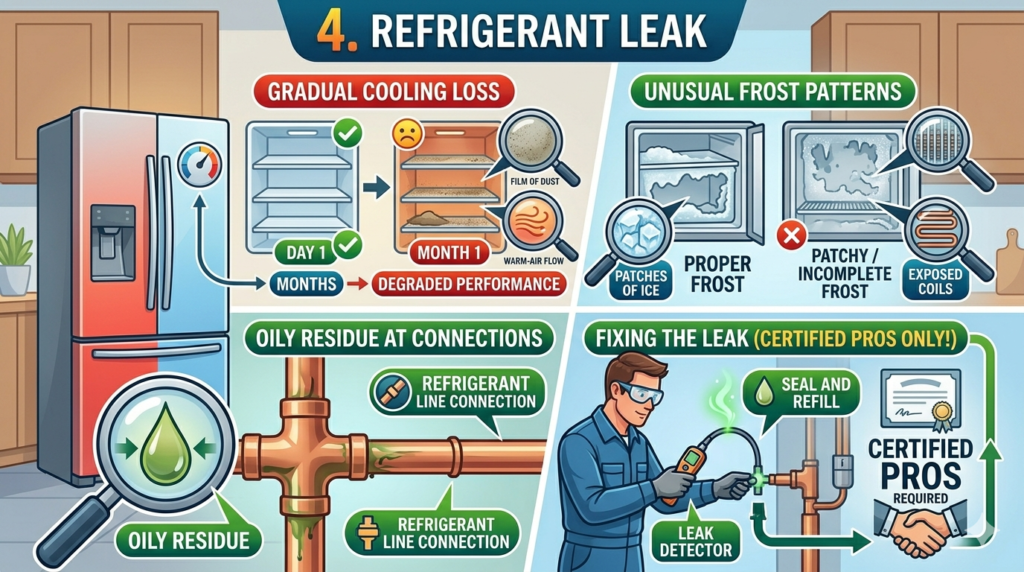
5. Refrigerant Leak
Refrigerant is the substance that circulates through the sealed cooling system and carries heat from inside the refrigerator to the condenser coils. A refrigerant leak reduces the amount of refrigerant in the system and degrades cooling performance.
Refrigerant leaks are less common than other cooling failures but do occur, particularly in older refrigerators. Symptoms include gradually worsening cooling over weeks or months, frost patterns that look unusual, and an oily residue near refrigerant line connections.
Refrigerant work must be performed by a certified technician. Adding refrigerant without locating and sealing the leak will only provide temporary cooling improvement.
6. Compressor Problems
The compressor is the heart of the refrigeration system. It compresses refrigerant gas and drives it through the cooling circuit. A failing compressor may run but produce insufficient pressure to cool the system effectively.
Compressor failure typically develops gradually. Early signs include longer run cycles, higher energy consumption, and slightly warmer-than-normal temperatures. As the compressor weakens further, cooling fails more dramatically.
Compressor diagnosis requires a technician to measure compressor amperage draw, start and run capacitor function, and refrigerant pressure. Compressor replacement is one of the more expensive refrigerator repairs, and on older appliances, it may not be economical compared to replacement.
7. Control Board Failure
The main control board manages all refrigerator functions, including compressor operation, fan speed, defrost cycles, and temperature regulation. A malfunctioning control board can disrupt any or all of these functions, causing cooling failure even when all individual components are physically intact.
Control board problems are often identified through the process of elimination. When a technician tests all individual components and finds them functional, but the system still does not operate correctly, the control board becomes the primary suspect.
What to Do While Waiting for Repair
-
- Keep the refrigerator and freezer doors closed as much as possible
-
- Move critical perishables to a cooler with ice
-
- Set the temperature controls to their coldest settings
-
- Avoid placing hot food inside the refrigerator, which adds heat load
-
- Place a thermometer inside to monitor temperature changes
Ready to schedule a repair? Contact DMV Appliance Care today. We serve the entire DMV area (DC, Maryland & Virginia). Call us at +1 (703) 991-2298 for fast, same-day appliance repair.