Introduction:
Your refrigerator does not make any noise. Quietly hums in the corner day after day, protecting your groceries, maintaining dairy fresh, and preserving leftovers for tomorrow’s lunch. Still, machines seldom stop without giving any notice. Your refrigerator sends out faint alarms long before a complete failure hits. Most homeowners just miss them. They discard a shelf that is just a little warm. They disregard a small puddle. They can handle the weird clicking sound. Then catastrophe strikes. Overnight, food goes bad. The kitchen is flooded with water. The freezer becomes a hot closet. The harm at that time had already started to show itself.
That is why early warning sign awareness is so important. An intervention at the right moment can help you save money, cut waste, and keep your kitchen operating smoothly. You already know the anxiety of waiting too long if you have ever searched at midnight for a refrigerator not cooling or fridge repair near me. Let us decipher the ten clear signs your appliance needs immediate care. More significantly, let’s investigate why taking swift action remains your best line of defense.
1. The Chill Factor Drops: Your Fridge Stops Cooling Properly
The stable temperature is like the heartbeat of every cooling device. Problems start right away when that rhythm breaks down. You will see it first in your groceries. Milk spoils more quickly. Overnight, leafy greens droop, or meat loses its natural color. This problem hardly arises unexpectedly. It sneaks in gently, and one day, the highest shelf seems a little warm. Then the crisper drawer totally loses its chill.
This syndrome is brought on by many undetected factors. When condenser coils are dirty, they trap heat and make the system work too hard. An evaporator fan that is failing obstructs the flow of cold air. A broken thermostat sends mixed signals to the control board. The compressor just loses power in extreme circumstances. Usually, the issue has expanded by the time you start looking for an answer. Early identification prevents little problems from becoming big catastrophes.
2. Unexpected Puddles: Water Pooling Beneath the Appliance
Water belongs in your pipes, not on your kitchen floor. Still, puddles underneath your fridge show up more often than you might imagine. At the top of the list is a clogged defrost drain. Ice, filth, or food waste clogs the thin tube. Water has nowhere to get out. Therefore it overflows. Cracked supply lines also leak quietly behind the unit. The drain pan may move, break, or flood during intense defrost cycles.
If left unchecked, moisture will seep into floors, warp cabinets, and create conditions for mold to grow. Standing water too near electrical equipment poses an unseen fire risk as well. Do not wait for the wet area to grow. usually reveals the precise leak source is a quick check. It doesn’t take long to clean the drain or put in a new line that has worn out. Ignoring it expenses hundreds.
3. Symphony of Strange Noises: Buzzes, Clicks, and Rattles
Every refrigerator hums and normal operation just means that sound. But what about loud buzzing, sharp clicks, or metallic rattling? That points to mechanical difficulties requiring assistance. An evaporator fan that isn’t working right scrapes against ice or stuff caught in it. Like a shaken tin can, a loose condenser fan blade rattles. Usually, repeated clicking indicates a compressor battling to start or a failing relay.
Stress mounts within the closed system as the motor gets louder and never fully stops. Parts that move wear down. The lubricant dries up. Electronics weariness. When one element fails, others fill in until they also collapse. Rarely do strange sounds correct themselves. They progress rapidly. Early detection preserves your cooling system intact and helps to reduce your expenditure.
4. Frost Takeover: Ice Blanketing the Freezer Walls
Freezers need to remain cold, not frozen solid. A malfunctioning defrost cycle is indicated by thick ice covering the walls, shelves, or food cartons. If the defrost heater breaks, the moisture never melts away. It builds up layer by layer. A defective thermostat might also turn off the automatic defrost timer. Warm, moist air enters through broken door gaskets. That extra dampness freezes right away.
Heavy frost blocks air flow vents. Cold air stops moving as it should. To make up for this, the compressor runs longer. The efficiency falls. The strain grows fast. If left unattended, ice accumulation might fracture internal liners or freeze fan blades closed. Before the system overloads, a professional technician restores the defrost sequence, replaces worn seals, and rebalances the airflow.
5. The Spoilage Alarm: Food Going Bad Too Quickly
Fresh food should be kept in a chilly area you can trust. Temperature instability is probably the cause when groceries go bad in days rather than weeks. Certain rooms remain cool, while others feel alarmingly hot, as dairy sours and berries mould. At the edges, frozen goods become soft or create icy clumps. This inconsistent cooling rarely implies one damaged component. Usually, it indicates limited airflow, malfunctioning sensors, or a compressor that is running out of steam.
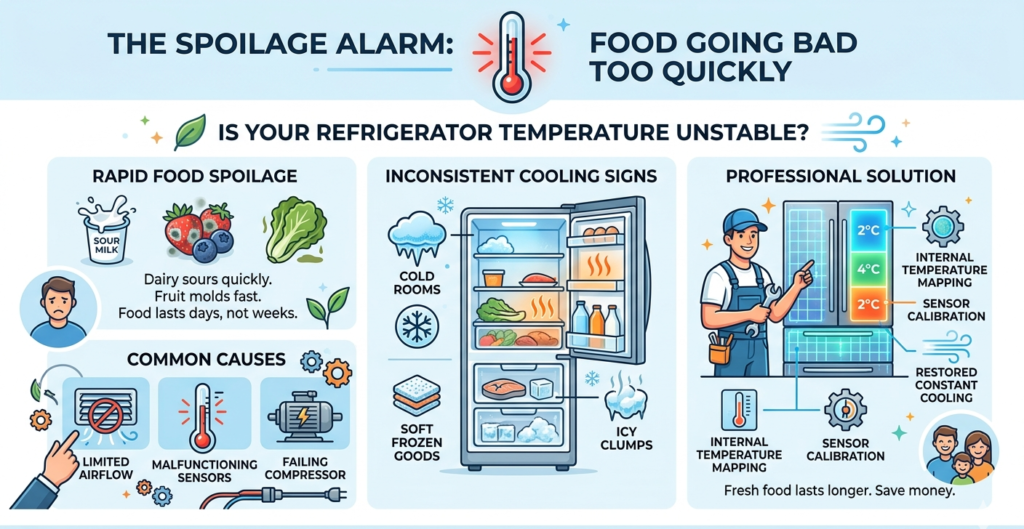
Many homeowners replace food several times before they blame the appliance. Spoilage depletes funds and irritates homes. An experienced technician maps internal temperature zones, checks sensor accuracy, and brings back constant cooling. When the system breathes correctly, fresh food remains fresh longer. .
6. The Marathon Runner: It Runs Nonstop Without Cycling Off
Refrigerators are made to cycle as they chill and then they rest. If your device runs nonstop, something is obviously wrong. Condenser coils covered in dust hold heat around the compressor. To get rid of that stored heat, the system works overtime. Worn door seals let cold air escape all the time. The fridge runs longer to make up for it. Over time, aging compressors also lose efficiency. Reaching target temperatures is a challenge for them. You get marathon sessions instead of fast cycles.
This design increases internal wear and accelerates electricity costs. Months before a complete failure happens, you will see increased utility expenses. A basic coil cleaning, seal replacement, or component test generally brings back regular cycling patterns.
7. The Heat Island: Outside Panels Feel Too Hot to Touch
Heavy cooling cycles cause the sides to remain mildly warm, which is normal. But very high heat? That points to a major red flag. Exhaust air gathers in obstructed ventilation gaps. Coils that are dirty function as insulation, trapping heat near the compressor. An inoperative condenser fan stops moving heat away from the back panel. Temperatures rise quickly. Overheating puts a strain on electrical wiring, breaks down insulation, and speeds up the failure of the compressor. Replacing a compressor costs a lot less than buying a brand-new unit. Early heat detection helps to protect the core of your refrigeration system. Clear vents, clean coils every three months, and call a professional if the panels feel hot to the touch.
8. Ice Maker Rebellion: Small, Slow, or Melted Cubes
Ice makers seldom break for no cause. They mirror the general condition of the complete freezer system. Look for little cubes, slow production, clumps trays, or melted puddles in the bin. Low water pressure usually results from kinked supply lines or blocked filters. Frozen water tubes cause total obstruction of flow. But temperature changes mess with ice formation as well. When the freezer fights to keep a constant chill, ice melts, refreezes, and bonds together.
Usually, these problems show up before the cooling system completely breaks down. Your ice maker will come back to life if you restore proper water flow, unclog frozen pipes, and adjust freezer temperatures. Regular ice generation points to a totally balanced system.
9. Lingering Odors: Bad Smells That Won’t Leave
A fridge that is clean should not smell like anything at all. Strong, lingering odors point to undetected problems. Clogged drains trap water that doesn’t move and become a breeding ground for germs. Behind drawers, close to old seals, or within neglected cabinets, mold grows especially well. Bad airflow moves stale air instead of cool, filtered fresh air. Rarely do these odors disappear with surface wipes or baking soda. The fountain remains far below within.
Technicians gently follow water trails, clear obstructed passages, and sterilize secret areas. Getting rid of the underlying cause returns natural fresh air. When the system is once again running smoothly, smells go away.
10. The Bill Spike: Your Electricity Costs Suddenly Climb
Your fridge operates twenty-four hours a day. Every day of the week, little inefficiencies add up fast. An inefficient compressor uses additional electricity. Coils that are blocked cause the machine to run for a longer time. Defective fans consume energy instead of effectively circulating air. Errors in the thermostat set off unwanted cooling cycles. Homeowners typically attribute fresh appliances elsewhere or seasonal rate increases. A fridge that isn’t working properly will quietly use energy from your meter. Usually, energy waste shows up months before complete failure. Professional diagnoses bring efficiency back, which naturally lowers bills. Over time, smart maintenance pays for itself.
Why Ignoring These Signs Costs You More Than You Think
Inside a closed cooling system, little problems never remain little. Pressure mounts. Stress travels. A little leak damages the floor. An inefficient compressor gets too hot. An obstructed drain causes mold to grow. Postponed repairs turn easy fixes into emergency replacements. Food leftovers accumulate quickly. Quietly, utility bills rise. Standing water poses lurking safety hazards. Acting fast safeguards your investment. Professional technicians identify covert flaws before they cascade.
When to Call a Professional Refrigerator Repair Service
DIY fixes work perfectly for light bulb swaps or shelf adjustments. Cooling systems demand precision. Sealed components require specialized tools. Electrical diagnostics need trained eyes. When temperature drops, water pools, or strange noises persist, professional help becomes essential. A certified technician tests pressure levels, measures airflow, verifies sensor accuracy, and isolates failing parts accurately. They replace worn components safely and recalibrate systems for peak performance. Searching for a reliable Refrigerator repair service ensures transparent pricing, warranty-backed work, and lasting results. Expert care keeps your kitchen running without interruption.
Trusted Refrigerator Repair in the DMV Area
Homeowners across Washington, D.C., Maryland, and Virginia rely on fast, honest appliance care. DMV Appliance Care delivers precision diagnostics and lasting solutions. Our certified technicians handle every common and complex issue. We fix refrigerator not cooling emergencies, seal leaks, restore defrost cycles, and revive failing compressors. We also repair thermostat failures, fan motor damage, ice maker glitches, and temperature control errors. Every service includes transparent pricing, same-day availability, and performance guarantees. We do not just patch problems. We restore balance. Your appliance deserves expert attention. Schedule your service today and keep your kitchen running smoothly.