A microwave that runs, the light comes on, the turntable spins, the timer counts down, but produces no heat is one of the more disorienting appliance failures a homeowner can encounter. Everything looks normal from the outside. Nothing useful is happening on the inside.
This specific failure pattern has a defined set of causes. Some are simple fixes. Others involve high-voltage components that require a trained appliance technician to handle safely. Here is what you need to know.
Important Safety Note: Before Anything Else
Microwave ovens store dangerous levels of electrical charge in their capacitors even when the appliance is unplugged. The capacitor in a microwave can hold enough charge to cause serious injury. Do not open the microwave cabinet or attempt to access internal components yourself. Always call a qualified appliance repair technician for any microwave repair that goes beyond cleaning or replacing the light bulb.
1. The High-Voltage Diode Has Failed
The high-voltage diode is a component that converts the AC power from the transformer into the DC power that the magnetron requires to generate microwave energy. When the diode fails, the magnetron receives insufficient power and produces no heat, or produces very little heat intermittently.
A failed diode sometimes produces a loud buzzing or humming sound during operation. The microwave runs normally in every other respect. Diode failure is one of the most common causes of no-heat microwaves and is a relatively affordable repair when performed by a technician.
2. The Magnetron Has Failed
The magnetron is the core component that actually generates microwave energy. It converts high-voltage electricity into the microwave radiation that heats food. A failed magnetron means the microwave can go through its entire cycle without producing any heat whatsoever.
Magnetron failure is confirmed through testing with a technician’s diagnostic tools. Replacement is one of the more expensive microwave repairs, and on a microwave that is more than seven or eight years old, the cost of magnetron replacement may approach the cost of a new appliance. A technician can help you evaluate which option makes more financial sense.
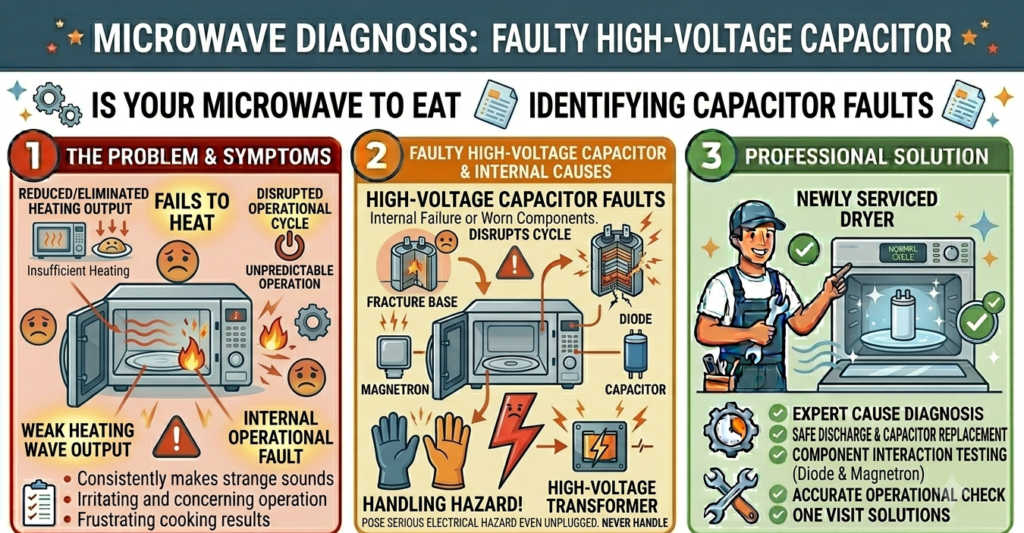
3. The High-Voltage Capacitor Is Faulty
The capacitor works in tandem with the diode to power the magnetron. It stores and releases electrical charge in a cycle that drives microwave output. A failing capacitor disrupts this cycle and reduces or eliminates heating output. As noted above, the capacitor poses a serious electrical hazard even with the microwave unplugged and should never be handled by anyone other than a trained technician.
4. The Door Switches Have Failed
Microwaves have multiple door interlock switches, typically three, that must all close correctly when the door shuts before the microwave will generate energy. This is a safety system that prevents microwave radiation from emitting through an open door.
If one of these switches fails, the microwave’s control board receives an incorrect signal and disables the heating function, even though the timer and light operate normally. Door switch failure is one of the more common microwave issues and is one of the more straightforward repairs.
5. The Thermal Cut-Out or Thermal Fuse Has Tripped
Microwaves have thermal protection devices that cut power to the heating circuit if the appliance overheats. These can be triggered by blocked ventilation vents, using the microwave for extended periods without breaks, or an internal fault that caused a heat spike.
Make sure your microwave has adequate clearance on all sides for ventilation. If a thermal cut-out has tripped, it may reset after the microwave cools, but if it trips repeatedly, there is an underlying cause that needs diagnosis.
6. The Control Board Is Failing
If all major high-voltage components test correctly, the control board may be failing to send the command that activates the heating circuit. Control board failure in microwaves sometimes presents alongside display problems or buttons that stop responding, but it can also occur in isolation.
Repair or Replace: How to Decide
Microwaves have a typical useful lifespan of seven to ten years. For a microwave under five years old, repair is almost always the better financial decision for any single component failure. For a microwave approaching ten years of age, the repair cost should be weighed against the cost of a replacement, particularly when it involves a magnetron or control board.
An honest technician will tell you when replacement makes more sense than repair. That is always the approach at DMV Appliance Care.
Ready to schedule a repair? Contact Appliance Care today. We serve the entire DMV area (DC, Maryland & Virginia). Call us at +1 (703) 991-2298 for fast, same-day appliance repair.