Wondering how long home appliances last? Learn the average lifespan of refrigerators, washers, dryers, dishwashers, ovens, and more. Discover repair vs replacement tips, warning signs, maintenance advice, and expert guidance from Appliance Care.
Home appliances are among the biggest investments homeowners make after purchasing a home. From keeping food fresh to washing clothes and preparing meals, these essential systems work every day, often without much attention until something goes wrong.
One of the most common questions homeowners ask is how long do home appliances last before they begin experiencing problems. While every appliance eventually reaches the end of its usable life, many can continue operating efficiently for years with proper maintenance, timely repairs, and responsible usage habits.
Understanding how long do home appliances last helps homeowners avoid unnecessary replacements, plan for future expenses, and recognize when a professional repair makes more financial sense than buying a brand-new unit.
In this guide, we’ll explore the average lifespan of home appliances, discuss the warning signs that indicate repairs are needed, explain appliance repair vs replacement, and share maintenance strategies that help extend the life of your household appliances.
Why Appliance Lifespan Matters
Most homeowners don’t think about appliance age until a refrigerator stops cooling or a washer refuses to spin. Unfortunately, waiting until complete failure often leads to emergency repairs, food spoilage, laundry delays, and unexpected expenses.
Knowing how long do home appliances last allows you to:
- Budget for future replacements
- Schedule preventive inspections
- Catch small problems before they become major failures
- Improve home energy efficiency
- Reduce repair costs over time
- Extend appliance performance
Every appliance has a different expected appliance lifespan, depending on its design, frequency of use, installation quality, maintenance history, and environmental conditions.
While manufacturers provide estimated service life, actual performance varies significantly from one household to another.
Factors That Affect Appliance Lifespan
Many homeowners assume appliances simply “wear out with age.” In reality, several variables determine how long equipment remains reliable.
Frequency of Use
Daily operation naturally creates more wear on motors, compressors, heating elements, bearings, belts, and electronic controls.
A refrigerator operates continuously, while an oven may only be used a few times each week.
More operating hours generally mean a shorter appliance lifespan.
Preventive Maintenance
Routine cleaning and inspections have one of the biggest impacts on longevity.
Simple maintenance tasks include:
- Cleaning refrigerator condenser coils
- Removing lint from dryer vents
- Cleaning dishwasher filters
- Inspecting water supply lines
- Replacing damaged door seals
- Leveling appliances correctly
Regular preventive maintenance helps reduce unnecessary strain on moving components and prevents premature breakdowns.
Installation Quality
Improper installation can shorten appliance life dramatically.
Examples include:
- Unlevel washing machines causing excessive vibration
- Poor refrigerator ventilation leading to compressor overheating
- Incorrect electrical connections damaging control boards
- Improper drainage causing dishwasher failures
Professional installation often protects your investment for years to come.
Water Quality
Hard water causes mineral buildup inside:
- Dishwashers
- Washing machines
- Ice makers
- Refrigerators with water dispensers
Mineral deposits reduce efficiency and accelerate wear on pumps, valves, and heating components.
Maintenance Habits
Homeowners who routinely ignore unusual noises, leaks, or warning lights often experience larger failures later.
Addressing small issues early keeps repair costs significantly lower than waiting until multiple components fail simultaneously.
Does Brand Matter?
Many homeowners believe expensive appliances automatically last longer.
While build quality certainly plays a role, maintenance often has a greater influence on longevity than brand alone.
Even premium appliances require:
- Proper cleaning
- Routine inspections
- Timely repairs
- Correct installation
- Manufacturer-approved maintenance
Following manufacturer recommendations helps maximize reliability regardless of brand.
Ignoring those recommendations, however, can shorten appliance life considerably.
How Usage Habits Affect Appliance Life
Daily habits influence durability more than many people realize.
For example:
- Overloading a washing machine strains suspension systems, bearings, and drive motors.
- Running a dishwasher with clogged filters forces pumps to work harder.
- Blocking refrigerator vents prevents proper airflow.
- Slamming microwave doors may damage door switches.
- Using excessive detergent creates residue inside washing machines.
These seemingly minor habits gradually reduce energy efficiency, increase wear, and shorten service life.
Changing just a few routines can add years to appliance performance.
Repair or Replace? Start With the Appliance’s Age
One of the biggest homeowner dilemmas is deciding between fixing an appliance or purchasing a new one.
Before making that decision, determine:
- Appliance age
- Repair history
- Overall condition
- Remaining expected lifespan
- Availability of replacement parts
If your appliance is relatively young and the repair is minor, professional service is often the most economical solution.
However, if it’s approaching the average lifespan of home appliances for its category and requires expensive repairs, replacement may provide better long-term value.
We’ll examine appliance repair vs replacement in greater detail later in this guide.
Early Signs Your Appliance Needs Repair
Many appliances provide warning signs long before complete failure occurs.
Recognizing these symptoms early can prevent extensive damage and reduce repair expenses.
Common signs your appliance needs repair include:
- Unusual noises
- Water leaks
- Burning odors
- Longer operating cycles
- Inconsistent temperatures
- Excessive vibration
- Error codes
- Frequent breaker trips
- Poor cleaning or drying performance
- Rising utility bills
These symptoms often indicate small mechanical or electrical problems that become more expensive if ignored.
How Long Do Home Appliances Last? Appliance-by-Appliance Lifespan Guide
Understanding how long do home appliances last becomes much easier when you examine each appliance individually. Every household appliance experiences different levels of wear and has unique maintenance requirements. Knowing what to expect helps you recognize problems early and decide whether repair or replacement makes the most financial sense.
Below is a closer look at the lifespan of the most common household appliances and the warning signs that indicate professional service may be needed.
Refrigerator
Average Lifespan: 10–15 years
Your refrigerator operates 24 hours a day, making it one of the hardest-working appliances in your home. Although modern refrigerators are built for durability, continuous operation eventually wears down compressors, fans, thermostats, and sealed system components.
If you’re wondering how long should appliances last, refrigerators typically remain reliable for over a decade when properly maintained.
Common Signs Your Refrigerator Needs Repair
Some warning signs should never be ignored because they can quickly lead to food spoilage.
Common signs your appliance needs repair include:
- Food spoils faster than usual
- Interior temperature fluctuates
- Ice buildup inside the freezer
- Water leaking underneath
- Loud buzzing or clicking noises
- Motor running constantly
- Warm exterior cabinet walls
These problems often start small but can increase repair costs if left unresolved.
Repair or Replace?
If your refrigerator is under ten years old and requires a thermostat, fan motor, or control board replacement, repair is usually worthwhile.
However, if the compressor or sealed cooling system fails after 13–15 years, the replacement cost may offer better long-term value than extensive repairs.
Washing Machine
Average Lifespan: 10–14 years
Washing machines handle heavy loads, high-speed spinning, water pressure, and constant vibration. Their lifespan depends heavily on usage habits and routine maintenance.
Many homeowners asking how long do home appliances last are surprised that washing machines can exceed 15 years with proper care.
Common Warning Signs
Typical indicators include:
- Excessive vibration
- Water leaking underneath
- Clothes remain soaking wet
- Drum won’t spin
- Grinding noises
- Burning smell
- Error codes appearing repeatedly
Ignoring these symptoms often increases repair costs because additional components begin failing.
Repair or Replace?
A newer washer with pump, belt, or valve issues is usually worth repairing.
If major bearing failure, transmission damage, or multiple electronic failures occur after 12 years, replacement often becomes the smarter investment.
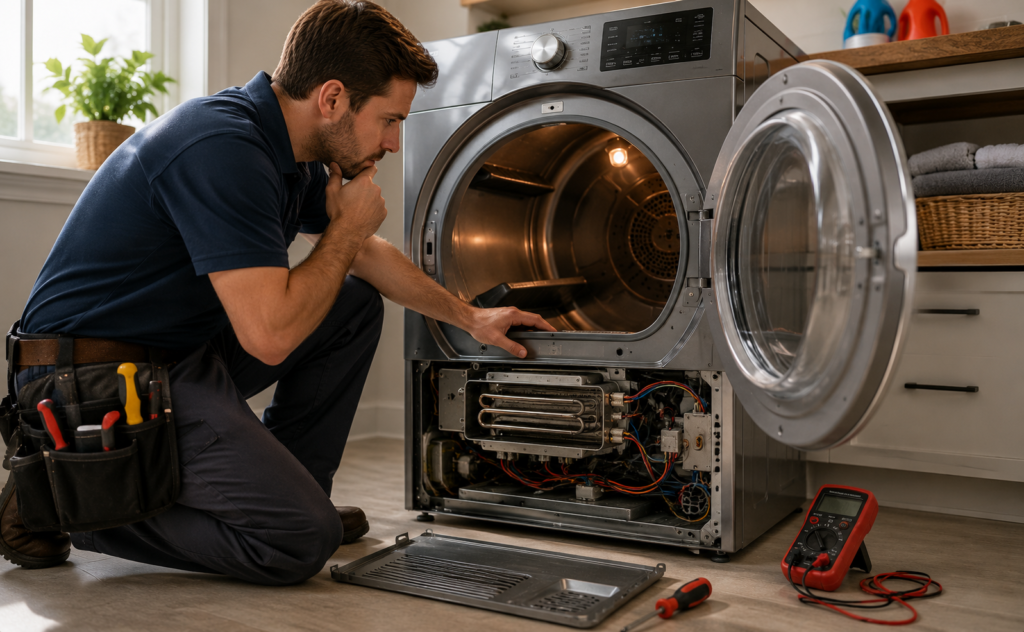
Dryer
Average Lifespan: 10–13 years
Dryers generally have fewer water-related problems than washers but experience significant heat and airflow stress.
One of the biggest reasons dryers fail prematurely is poor preventive maintenance, especially neglected dryer vent cleaning.
Signs Your Dryer Needs Service
Watch for:
- Clothes taking multiple cycles to dry
- Burning odors
- Drum not turning
- Excessive heat
- Loud squealing noises
- Dryer shutting off unexpectedly
- No heat during operation
Many homeowners searching how long do home appliances last discover their dryer’s lifespan depends largely on keeping vents clean.
Repair or Replace?
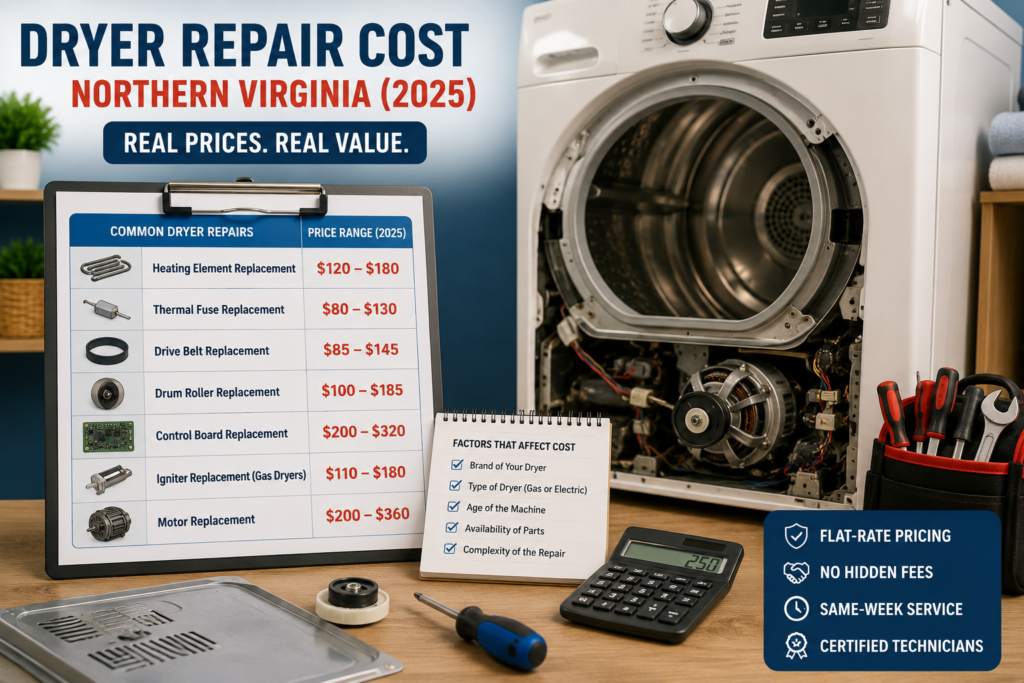
Heating elements, thermostats, rollers, and belts are relatively affordable repairs.
Older dryers with failing motors or multiple worn components may justify replacement, especially if declining energy efficiency has increased utility bills.
Dishwasher
Average Lifespan: 9–12 years
Dishwashers combine water, heat, electronics, and moving parts in every cycle. Mineral buildup and neglected cleaning often shorten service life.
Common Problems
Look for:
- Dishes remain dirty
- Standing water after cycles
- Water leaking
- Door won’t latch
- Strange grinding sounds
- Poor drying performance
- Unpleasant odors
These are common signs your appliance needs repair before complete failure occurs.
Repair or Replace?
Replacing pumps, spray arms, inlet valves, or door latches is usually cost-effective.
Older machines with repeated electronic failures may no longer justify ongoing service.
Oven and Range
Average Lifespan: 13–16 years
Electric and gas ovens generally outlast many kitchen appliances because they contain fewer continuously moving components.
Following manufacturer recommendations for cleaning and inspection helps extend their service life.
Common Warning Signs
Pay attention if you notice:
- Uneven cooking temperatures
- Burners failing to ignite
- Oven not heating properly
- Temperature inconsistencies
- Gas odors
- Display panel failures
Repair or Replace?
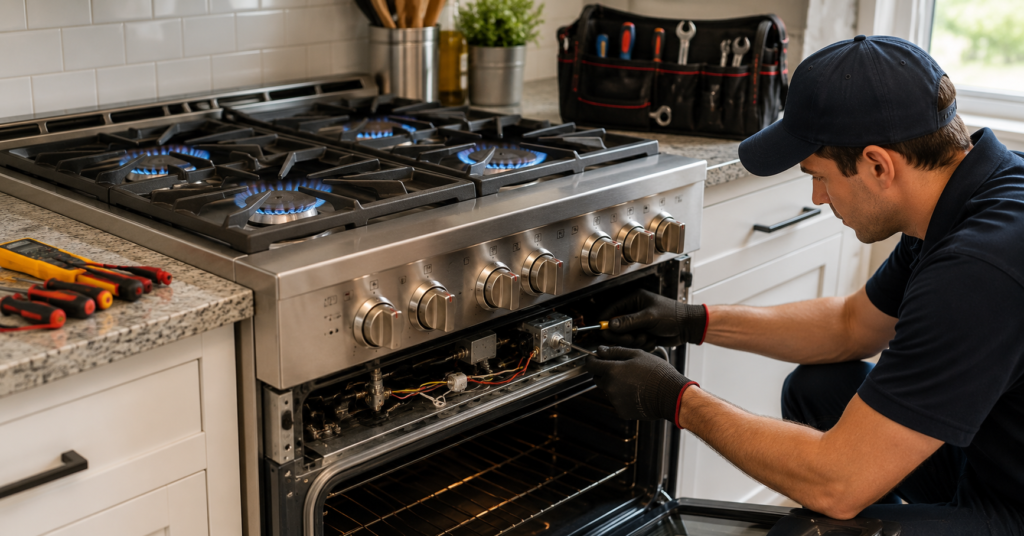
Heating elements, igniters, and thermostats are common repairs.
If control boards become unavailable or multiple systems begin failing in older units, replacement may provide greater reliability.
Microwave
Average Lifespan: 7–10 years
Microwaves generally have one of the shortest expected service lives among kitchen appliances.
Heavy daily use accelerates wear on switches, door latches, magnetrons, and electronic controls.
Signs of Trouble
Watch for:
- Food heating unevenly
- Sparking inside the cavity
- Turntable not rotating
- Door failing to close properly
- Loud humming noises
- Control panel not responding
Repair or Replace?
Small repairs may be worthwhile for newer units.
Because replacement cost for many countertop models is relatively low, replacement often becomes the better option after several years.
Garbage Disposal
Average Lifespan: 8–15 years
Garbage disposals experience heavy mechanical stress every day.
Improper use significantly reduces lifespan.
Avoid placing:
- Grease
- Bones
- Coffee grounds
- Fibrous vegetables
- Eggshells
into the disposal whenever possible.
Common Signs
Problems include:
- Frequent jams
- Water leaks
- Persistent humming
- Slow drainage
- Unpleasant odors
- Complete failure to start
Routine cleaning is an important part of preventive maintenance that keeps disposals operating efficiently.
Freezer
Average Lifespan: 12–16 years
Standalone freezers generally last longer than many other kitchen appliances due to their simpler operating cycles.
Maintaining proper airflow and cleaning condenser coils improves energy efficiency while reducing wear on compressors.
Warning Signs
Call for service if you notice:
- Frost buildup
- Soft frozen food
- Continuous running
- Water leaks
- Temperature fluctuations
- Unusual compressor noises
Many freezer problems can be corrected before major compressor damage occurs.
Ice Maker
Average Lifespan: 4–8 years
Ice makers experience constant water flow, freezing cycles, and mineral buildup, making them one of the shortest-lived kitchen appliances.
Common Problems
Look for:
- Small ice cubes
- Slow ice production
- Water leaks
- Ice with unusual taste
- Ice clumping together
- Complete production failure
Water quality plays a significant role in overall reliability.
Following manufacturer recommendations for filter replacement helps extend performance.
Which Appliances Usually Last the Longest?
Among major household appliances, ovens, freezers, and refrigerators typically have the longest service lives.
Appliances with more moving parts, such as washers, dryers, dishwashers, and ice makers, generally require repairs sooner because motors, pumps, bearings, and valves experience greater mechanical wear.
While homeowners frequently ask when should you replace household appliances, age alone shouldn’t determine the answer. A well-maintained appliance can often continue operating efficiently beyond its expected lifespan, whereas neglected equipment may fail years earlier.
Likewise, understanding appliance repair vs replacement requires evaluating repair costs, remaining service life, and overall condition rather than relying solely on the appliance’s age.
Appliance Repair vs. Replacement: How to Make the Right Decision
One of the biggest questions homeowners face is whether to repair an aging appliance or invest in a new one. While every situation is different, understanding appliance repair vs replacement can save you hundreds, or even thousands, of dollars.
The right decision depends on several factors, including the appliance’s age, repair history, performance, and expected remaining lifespan.
If you’ve been wondering how long do home appliances last, remember that lifespan estimates are only guidelines. Some appliances continue working reliably for years beyond their expected life, while others require replacement much sooner due to heavy use or poor maintenance.
The 50% Rule
A commonly used guideline in the appliance repair industry is the 50% Rule.
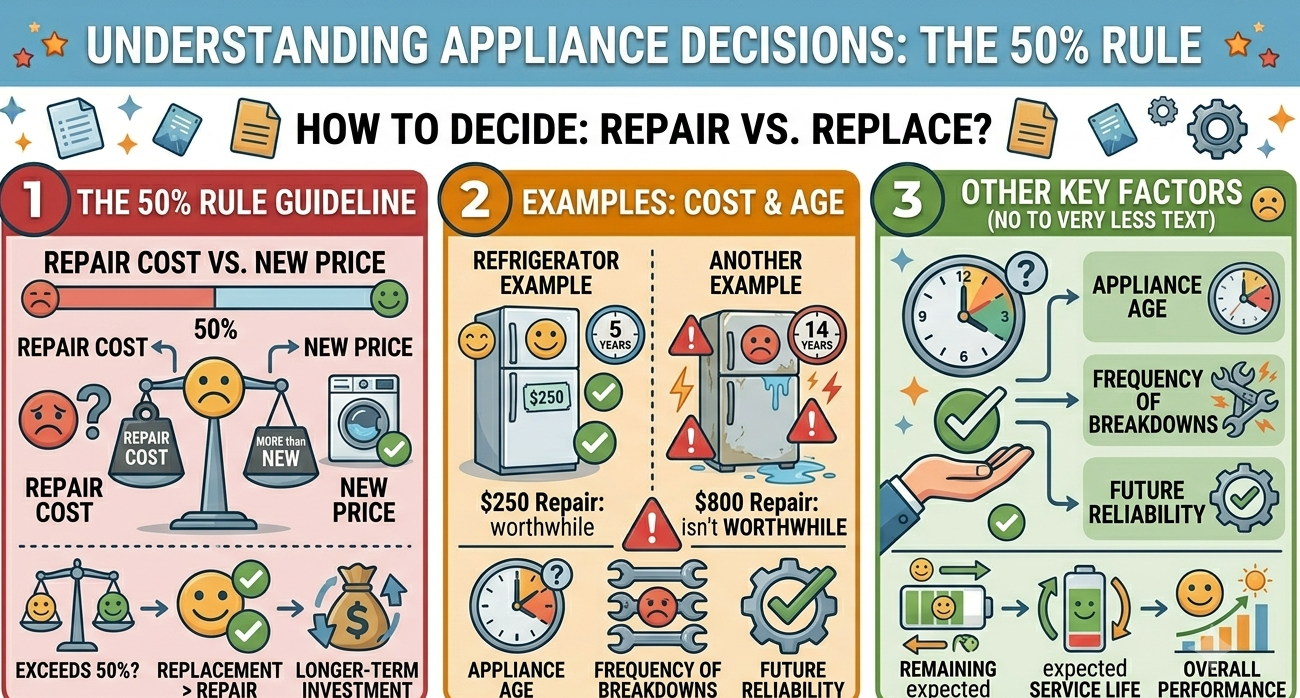
If the estimated repair costs exceed 50% of the price of a comparable new appliance, replacement is often the better long-term investment.
For example:
- A $250 repair on a five-year-old refrigerator may be worthwhile.
- An $800 repair on a 14-year-old refrigerator often isn’t.
However, cost alone shouldn’t determine the decision.
Also consider:
- Appliance age
- Frequency of breakdowns
- Future reliability
- Remaining expected service life
- Overall performance
This approach helps homeowners make smarter decisions about appliance repair vs replacement instead of automatically replacing every malfunctioning appliance.
When Repair Is Usually the Better Option
Professional repairs often provide excellent value when:
- The appliance is less than halfway through its expected lifespan.
- The repair involves a single replaceable component.
- Replacement parts are readily available.
- The appliance has been well maintained.
- Performance has otherwise remained reliable.
In many cases, repairing a relatively new appliance extends its usable life by several years while avoiding unnecessary expenses.
When Replacement Makes More Sense
There comes a point when replacing an appliance becomes the more practical and economical decision.
You should consider replacement if:
- The appliance has exceeded its expected lifespan.
- It requires frequent service calls.
- Major components have failed.
- Replacement parts are discontinued.
- Utility bills continue increasing due to declining energy efficiency.
- Multiple repairs have already been performed.
Understanding when should you replace household appliances involves balancing repair expenses with long-term reliability rather than focusing only on the immediate cost.
Consider Warranty Coverage
Before scheduling repairs or shopping for a replacement, always check your warranty.
Many homeowners forget that certain parts may still be covered even after the standard labor warranty expires.
Common warranty types include:
- Manufacturer limited warranty
- Extended protection plans
- Home warranty coverage
- Parts-only warranties
Reviewing your coverage could significantly reduce repair expenses.
How Energy Efficiency Influences Replacement Decisions
Older appliances generally consume more electricity and water than modern models.
While an older appliance may still function, declining energy efficiency can increase monthly utility bills over time.
Newer appliances often feature:
- Improved insulation
- Variable-speed motors
- Smarter temperature controls
- Water-saving technology
- Advanced compressors
If an older appliance is approaching the end of its service life and operating inefficiently, replacement may reduce long-term operating costs despite the initial investment.
Simple Ways to Extend Appliance Lifespan
While no appliance lasts forever, proper care can significantly extend its usable life.
Follow these maintenance habits:
- Clean refrigerator condenser coils every six to twelve months.
- Empty and clean dishwasher filters regularly.
- Clean dryer lint filters after every load.
- Schedule annual dryer vent cleaning.
- Avoid overloading washers and dryers.
- Replace refrigerator water filters on schedule.
- Inspect water supply hoses for wear.
- Keep appliances level to reduce vibration.
- Address unusual noises immediately.
- Schedule professional inspections when needed.
Routine maintenance reduces unnecessary wear while helping appliances operate safely and efficiently.
Why Professional Repairs Matter
Attempting complex appliance repairs without proper training can often create additional damage.
Certified technicians can:
- Diagnose problems accurately.
- Replace defective components correctly.
- Test appliance safety.
- Prevent secondary failures.
- Help maximize remaining service life.
Professional service also ensures repairs comply with manufacturer specifications whenever possible.
Final Thoughts
Knowing how long do home appliances last helps homeowners plan ahead, avoid emergency breakdowns, and make informed repair decisions. While every appliance has an expected service life, proper maintenance, prompt repairs, and responsible daily use can often extend that lifespan well beyond industry averages.
If your refrigerator isn’t cooling, your washer won’t spin, your dryer takes multiple cycles, or your dishwasher no longer cleans effectively, don’t assume replacement is your only option.
At Appliance Care, our experienced technicians diagnose appliance problems honestly and recommend the most cost-effective solution based on the appliance’s condition, age, and repair needs. Whether you need routine maintenance, expert repairs, or guidance on replacement, we’re here to help keep your home running smoothly.